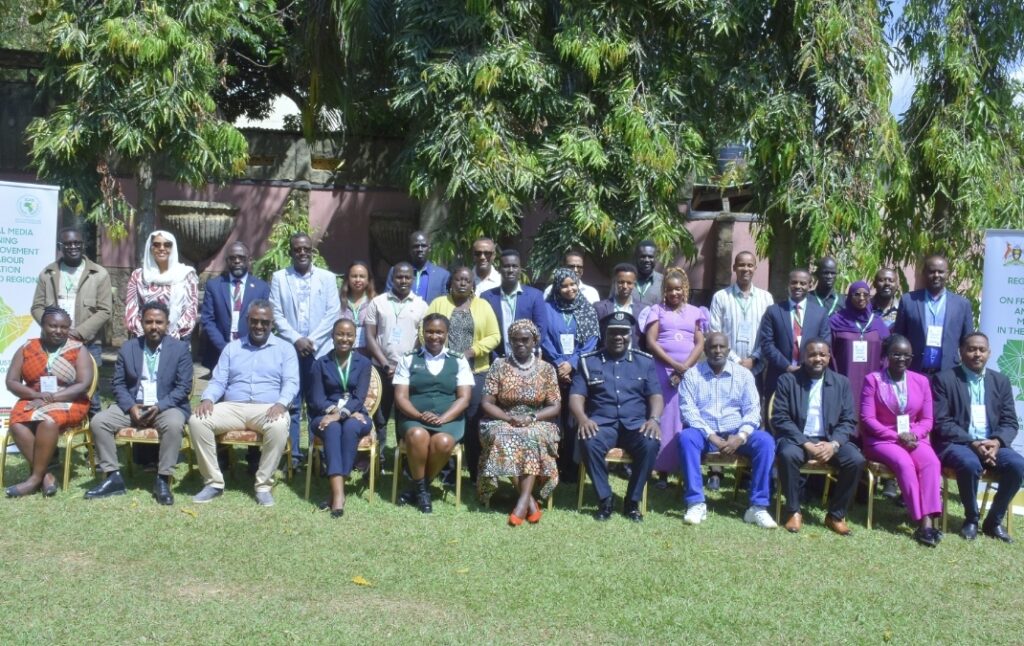
Over 20 media professionals from all seven IGAD member states have completed a three-day training on reporting and communicating on free movement of persons, labour migration and regional integration.
The training, held from 24th to 26th August in Entebbe, Uganda, brought together senior policy officers from ministries of information, journalists from television, print and government media, as well as members of journalist unions and associations in the region.
The workshop was organised by the IGAD Secretariat to deepen understanding of migration governance and responsible reporting on migration.
Five States Have Signed Free Movement Protocol – IGAD
Speaking at the training, Lucy Daxbacher, Senior Migration Expert at the IGAD Secretariat in Djibouti, who is in charge of the IGAD Protocol on Free Movement of Persons, said the protocol seeks to establish a visa-free IGAD region.
“That Protocol on Free Movement of Persons establishes a visa-free region, the right of entry, stay and exit for our citizens, the right to mobility of labour in our region, the right of residence and the right of establishment,” Daxbacher said.
She explained that the 1986 IGAD Agreement enjoins member states to progressively establish a free movement regime to facilitate trade, access to basic services, access to safety and as a solution to displacement caused by natural and man-made disasters.
According to Daxbacher, five out of seven member states have signed the protocol, that is, Uganda, Sudan, South Sudan, Somalia and Ethiopia. Djibouti and Kenya are yet to sign but are in discussions with the Secretariat.
“Five out of seven IGAD member states have signed this protocol. That is the governments of Uganda, Sudan, South Sudan, Somalia, and Ethiopia. The governments of Djibouti and Kenya have not yet signed the protocol, but they are studying it and holding discussions with the IGAD Secretariat,” she said.
Daxbacher further noted that the Entebbe training is the first of its kind where journalists have been brought on board as key promoters of the free movement regime.
“Migration is not a crime but a facilitator to safety, protection, development, prosperity, peace and security, and access to employment,” she said.
She revealed that with about 300 million citizens in the IGAD region, 60% of whom are youth, labour migration remains a critical issue that must be reported responsibly.
Interpol, Immigration Officers Highlight Trafficking Threat
The Interpol Senior Commissioner of Police Fred Enanga and Senior Immigration Officer Juliet Akelo took participants through transnational organised crime, trafficking in persons and smuggling of migrants.
Enanga said trafficking can occur within a country or across borders, with criminal networks exploiting human mobility for profit.
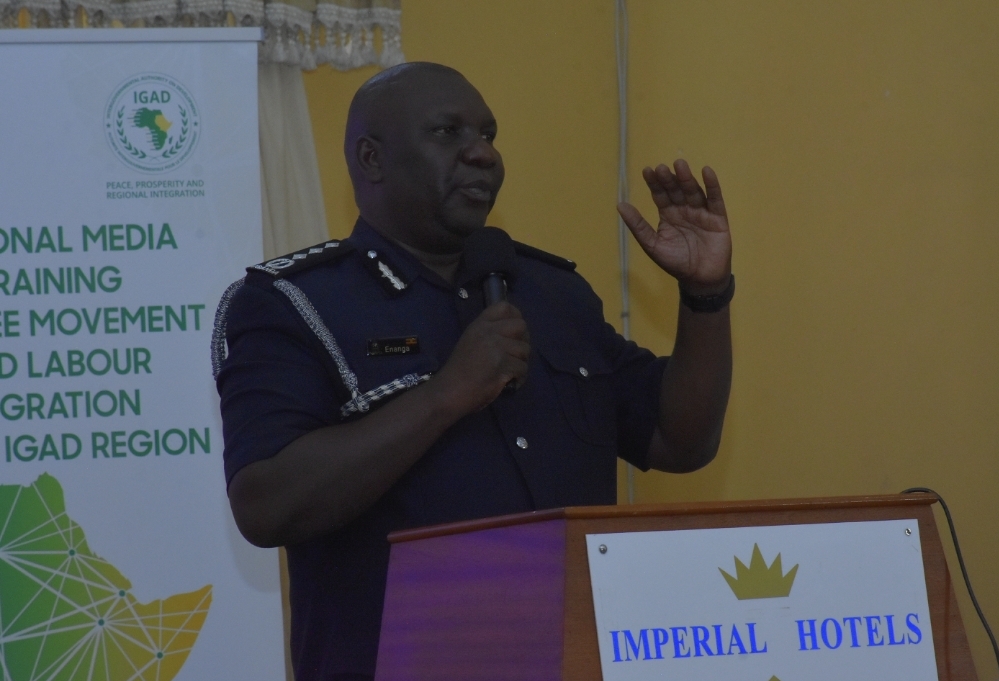
“You need to be aware that trafficking can occur within a country or across borders, and then criminal networks exploit human mobility for profit. As responsible media practitioners, reporting can help prevention and also protect people,” Enanga said.
“Victims do require protection; their dignity is important, and appropriate support, and then criminal networks must be investigated, disrupted.”
He urged journalists to maintain cross-border networks, including WhatsApp groups, to follow regional stories and to work closely with police communicators to avoid compromising ongoing operations.
Enanga said Uganda has signed bilateral anti-trafficking MoUs with Ethiopia, Kenya, Rwanda and Tanzania, and has established formal and informal engagements between Attorneys General and DPPs in the region to facilitate extradition and intelligence sharing. He added that community policing programs have been intensified in vulnerable areas like Karamoja, Soroti and Mbale.
Daxbacher also lauded Uganda’s National Migration Policy 2025, describing it as a role model and landmark instrument for other IGAD member states, covering immigration, refugee management, IDPs, diaspora, integrated border management and migration statistics.
Why Djibouti and Kenya Have Not Signed
On why Djibouti and Kenya have not signed, Daxbacher said there is no challenge but sovereign consideration under Article 4 of the Protocol, which provides for progressive realisation.
“Each country can examine its capacity to manage high flows of migrants and high stock of migrants within the country, and then they can be able to decide to sign the protocol, ratify it, domesticate it,” she said, noting that the Secretariat continues to follow up with member states.
Journalists React
Wol Mapal, journalist at Eye Radio, South Sudan, said the training helped address misconceptions about the protocol.
“We have been guided on how we can shape the public perception and the misconceptions about this. Because there are a lot of misconceptions around this protocol. So it’s the role of the media now around the region to make sure that such misconceptions are addressed,” he said.

Grace Wafubwa, journalist at Kenya Broadcasting Corporation (KBC) and member of the Kenya Union of Journalists, said she learnt about joint interventions to intercept smugglers along transit highways.
“I learnt that there is much of an intervention ongoing in terms of intercepting illegal smugglers and human traffickers by setting major barriers at the transit highways, both in Kenya and in Uganda. They also share data; they also share information concerning intelligence,” Wafubwa said.
On Kenya’s delayed ratification, she said: “Of course, there are steps and processes that they are doing to ensure that particular certification will take place. But I cannot speculate on what time.”
The key message from the three-day training was that ‘migration is not a crime’, and safe, orderly and regular migration requires effective governance, regional cooperation and responsible journalism.