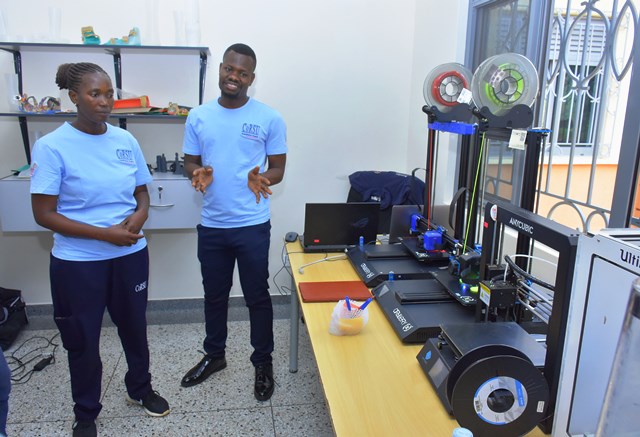
Joyce Nakibirango and Collins Olowo attending to the 3D printing machines at CoRSU rehabilitation hospital
Edwin Nakabuye, a resident of Bussi island in Wakiso district was born with a health condition that crippled her legs. Spent the first 15 years of her life crawling on the ground until she was taken to CoRSU rehabilitation hospital from where her legs were amputated and replaced with plastic limbs. Now 26 years old, Nakabuye cannot hide the joy of being able to stand upright and walk with no hesitation.
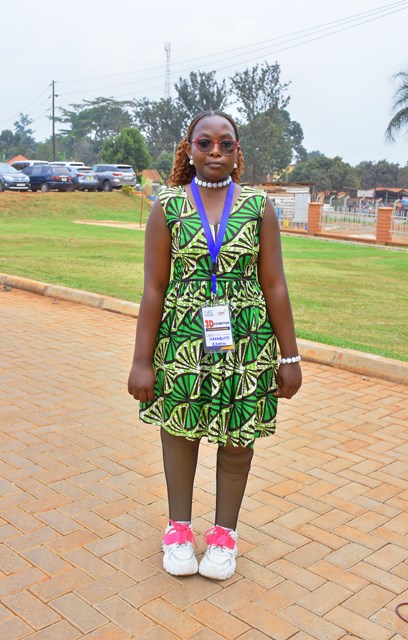
She is among the 1,000 patients who receive orthopedic and plastic surgeries every year at CoRSU. The hospital also provides over 3,000 assistive devices used in body movement as well as over 9,000 therapy sessions every year, according to Dorothy Namayanja, the head of programs and partnerships at CoRSU. Whereas several patients have received correctional treatment, there remains high demand for assistive devices for persons injured in accidents and other illnesses that affect the skeletal and nervous system.
3D technology
To address the high demand, 3D technology was introduced and rolled out at CoRSU rehabilitation hospital. Gloria Ndekezi Chimpaye, a physiotherapist who is also the head of rehabilitation services at CoRSU said the hospital is currently focussing on 3D innovations that have proved handy in making prosthetic devices for correcting deformities of feet, hands and making artificial legs.
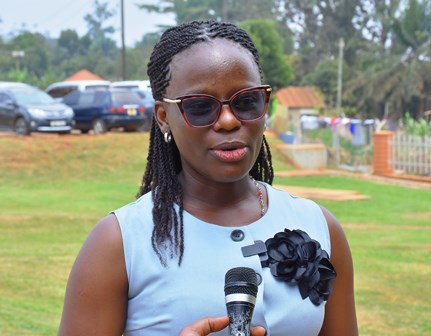
“We have been using labour-intensive methods that require a lot of material such as bandages, powders, among others. In the 3D digital technology, we scan the affected part(s) of the human body and take it to the orthopedic technologist who subsequently models the device using a computer software and prints out the prosthetic devices (artificial limbs) or orthotic devices (external supportive devices),” she further explained.
According to Ndekezi, the new technology is very fast compared to the conventional way of modeling that medics have been using. “It also helps us a lot to do customisation so that we meet the exact need of the patient for whom the device is being designed,” she stated.
Collins Olowo, the technologist managing the 3D laboratory also explained that the technology facilitates distant operations where one only needs to scan the patients from wherever they are, and send the details to the technologist to design the required orthotic devices.
“It used to take an average of two weeks to produce an artificial leg while using the conventional previous technology. However, with the 3D technology, it takes an average of 24 hours with all the processes of scanning, measurements, modeling and printing the required assistive device,” Olowo remarked.
Dorothy Mutabazi the programs officer at CoRSU hospital intimated that there is a rise in infections and non-communicable diseases among children such as diabetes which has consequently raised a demand for more assistive devices. She further noted that the cost of 3D technology and production of assistive devices at CoRSU is highly subsidised because several donor organisations have sponsored the new development.
Michiel Steenbeek, a global advisor under Christian Blind Mission (CBM), the main funding organisation at CoRSU, explained that 3D technology has been studied for more than ten years before being rolled out. “I believe that 3D technology is the future but not totally. We should keep our practical skills of orthopedic technology of doing conventional techniques. Whereas the new technology is something to reckon on, we must not lose our skills,” he advised.
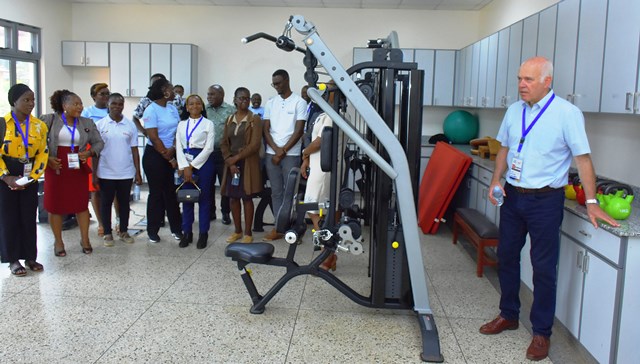
According to Steenbeek, the first trial collaboration in 3D technology was conducted in 2005 with a Canadian 3D social enterprise. “But we should make sure that computers and printers do not take over the medical field. We should be alert not to stop training and employing orthopedic technologists with hands-on experiences and skills,” added the CBM global advisor.