
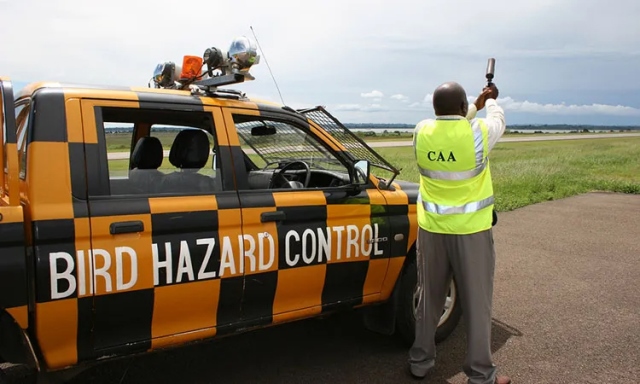
Bird hazard control team at Entebbe airport
Bird hazard management is one of the most unique and overlooked aspects of aviation safety yet, bird strikes cost the global aviation industry an estimate of up to $2b every year. Vianney Luggya, the public affairs manager for Uganda Civil Aviation Authority (UCAA) noted that a single bird strike can bring down an entire aircraft. “Yes, just one bird, if it enters a jet engine, can cause catastrophic failure, potentially costing lives and millions in damage,” he expressed.
Luggya was pointing out some of the opportunities in the aviation industry, including the bird hazard management department. He was talking to over 38 young learners aged between 6-15years who were being oriented in aviation studies by the DAS aviation school in Entebbe municipality. “When we talk of aviation safety, most people think of mechanical failures, weather challenges, or pilot error, forgetting that bird hazards are also dire,” Luggya stated.

He recounted a tragic incident of 1960, in Boston, USA, where a bird strike led to the crash of an aircraft, killing 62 people. “More recently, you may have heard of the ‘Miracle on the Hudson,’ where US Airways Flight 1549 safely ditched in the Hudson River after a flock of geese disabled both engines. Thankfully, all passengers survived, but it reminded the world just how serious bird strikes can be,” Luggya emphased.
The UCAA spokesperson intimated that at Entebbe international Airport, which lies within a known bird sanctuary, the challenge of bird strike is more pronounced. “That’s why UCAA has invested in a dedicated Bird Hazard and Wildlife control section, currently employing 23 professionals, with plans to increase the number as our air traffic increases and as new international airports are developed in Hoima, Arua, and Gulu,” Luggya assured, adding that the bird hazard department employs environmental scientists, biologists, and wildlife experts.
This was recently echoed by Eng. Ayub Sooma the director for airports and aviation security while meeting local communities staying and working around Entebbe airport. The UCAA management recently met with communities from Kigungu, Nakiwogo among other areas within Entebbe municipality during a sensitisation campaign on the proper management and disposal of garbage in order to regulate the flocks of birds around the airport. “Entebbe is a bird sanctuary, which is good for tourism, but also presents challenges for the aviation industry,” Sooma expressed.

The Entebbe peninsular sits on the migratory path of birds moving in and out of the northern and southern hemispheres. It is also surrounded by several bird-rich islands and wetlands. Meanwhile, Fred Bamwesigye, the UCAA director general says, the bird hazard management team ensures that flights remain safe by studying, understanding, managing and reducing the risk posed by birds and other wildlife to aircraft.
“The team uses an impressive array of tactics, including, runway sweeps with specialised vehicles before every takeoff and landing, bird scare pistols and distress call recordings to disperse flocks, foot patrols and grass height management to reduce nesting environments, waste management in collaboration with neighboring communities and advanced tools like laser bird repellents,” Bamwesigye explained.
According to the UCAA boss, there is an ongoing ecological study around Entebbe airport, aimed at understanding the habitats, species and human activities that attract birds within a 13-kilometer radius of the runway. “We’re also collaborating with the National Animal Genetics Resource Centre (NAGRC) to use DNA analysis to identify bird species involved in strikes, especially when they’re hit by aircraft beyond recognition as well as new bird species. This will allow us to tailor the mitigation efforts even more precisely,” Bamwesigye revealed.
While handing over certificates to young learners on Saturday, Luggya the UCAA public affairs manager noted that while bird hazard management sounds like some other activity, it is aviation too. “It is a side of the industry that rarely makes headlines, but remains crucial. It shows that you don’t have to be in a cockpit or cabin to have a critical impact on flight safety. You can be in a lab, on a research team, on the airfield with binoculars and data sheets, or working on policy and strategy from behind a desk,” Luggya advised the young learners pursuing interest and careers in aviation.